 ENG
 INA
Educational Workshop for the Dermatology and Venereology Specialist Study Program, Faculty of Medicine, Udayana University (FK Unud)
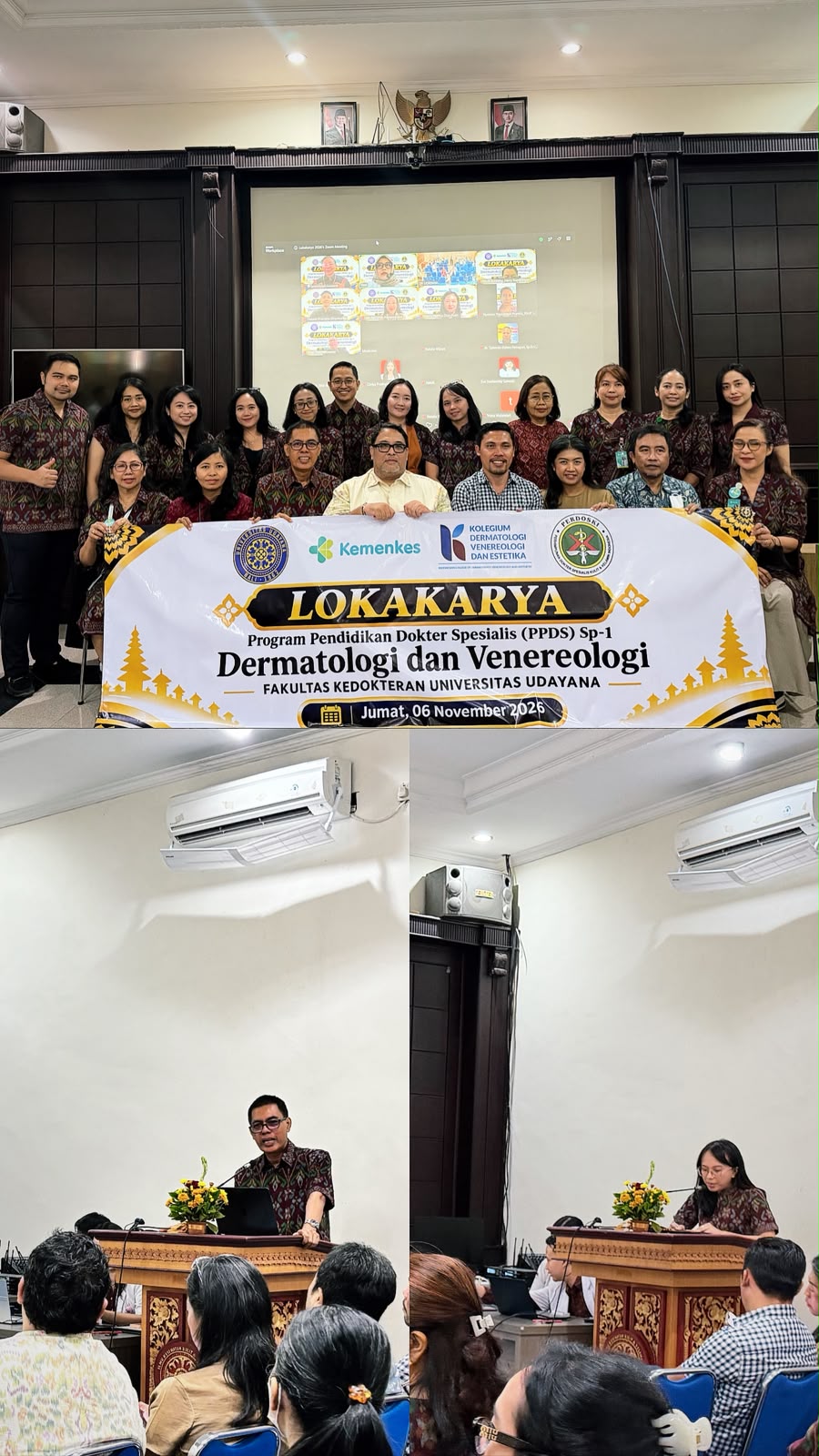
Educational Workshop for the Dermatology and Venereology Specialist Study Program, Faculty of Medicine, Udayana University (FK Unud)
The Dermatology and Venereology Specialist Study Program at the Faculty of Medicine, Udayana University (FK Unud), held an educational workshop aimed at strengthening the quality of specialist medical education. The workshop sought to align the study program’s vision, mission, strategic plan, and curriculum with advancements in scientific knowledge and national competency standards, while also preparing for the program’s accreditation in 2028.
The event, which took place on Friday, November 6, 2026, at the Secretariat of the Department of Dermatology and Venereology at Prof. Dr. I.G.N.G. Ngoerah General Hospital, Denpasar, brought together representatives from the faculty, the department, the study program, the Indonesian College of Dermatology, Venereology, and Aesthetics, the Denpasar branch of the Indonesian Society of Dermatology and Venereology (PERDOSKI), the Bali Provincial Health Office, affiliated teaching hospitals, as well as faculty members, students, and alumni to discuss comprehensive curriculum development.
The committee chair, Dr. dr. Indira Dharmasamitha, Sp.DVE, emphasized the significance of the workshop as part of the study program’s ongoing commitment to enhancing the quality of education, research, community service, and governance.
"Through this workshop, we hope to develop a curriculum that not only produces specialists who excel in their scientific field but also possess strong character, independence, and cultural awareness—specialists capable of making tangible contributions to the advancement of dermatology and venereology, both nationally and globally," stated Dr. dr. Indira Dharmasamitha, Sp.DVE.
The event was opened by the Dean of the Faculty of Medicine, Udayana University, Prof. Dr. dr. I Gede Eka Wiratnaya, Sp.OT(K), who underscored the importance of maintaining educational quality in line with the "Excellent" (Unggul) accreditation status already achieved by the study program. “An ‘Excellent’ (Unggul) rating must be reflected in the quality of education and the competence of graduates. While developing areas of specialization is important, the core competencies that every specialist physician must possess must remain the priority,” asserted the Dean of the Faculty of Medicine at Udayana University (FK Unud).
Strengthening Curriculum and Educational Competency Standards
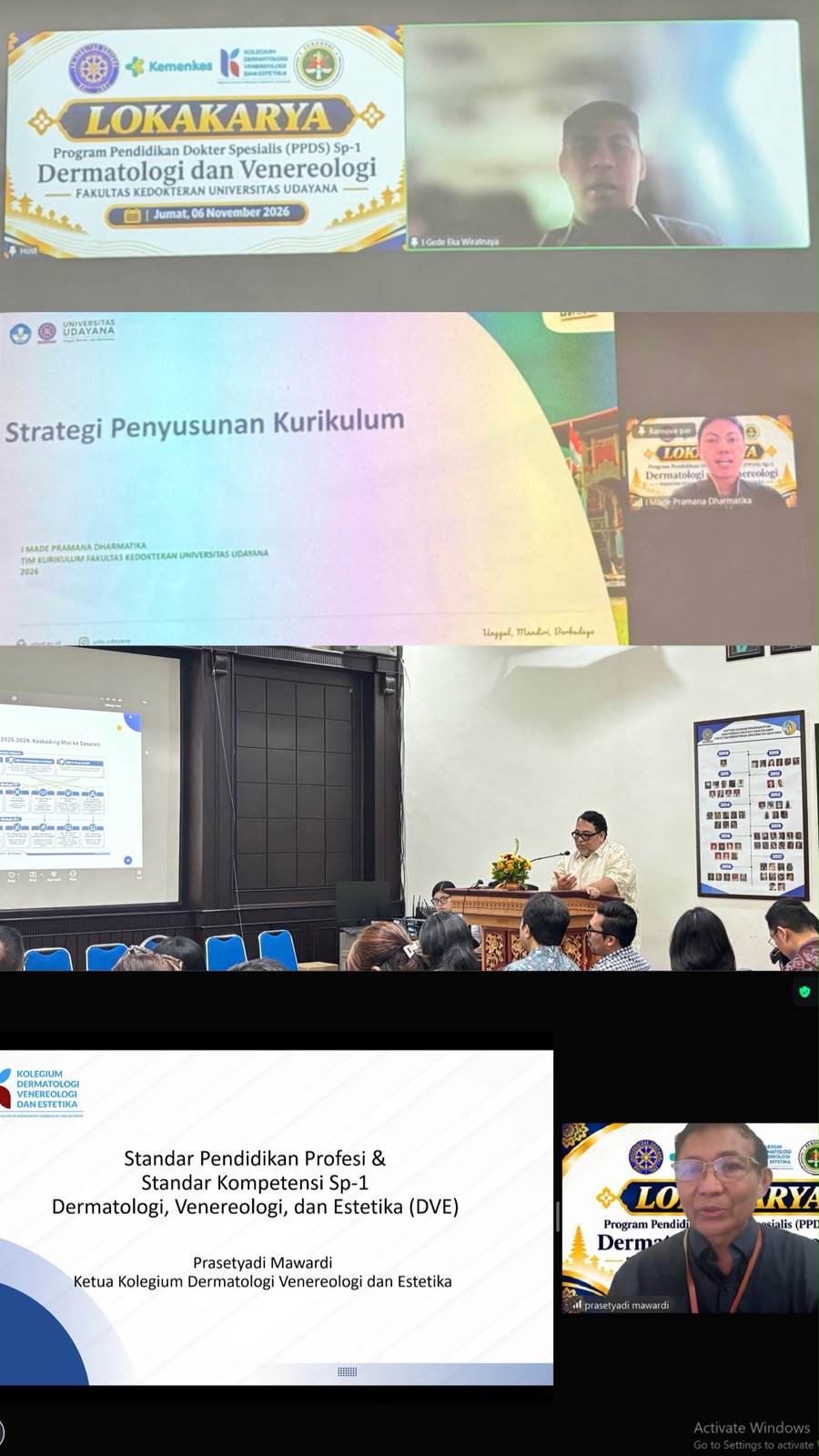
One of the primary agenda items of the workshop was a discussion on the Professional Education Standards and Competency Standards for specialists in Dermatology, Venereology, and Aesthetics, presented by the Chair of the Indonesian College of Dermatology, Venereology, and Aesthetics, Dr. dr. Prasetyadi Mawardi, Sp.D.V.E., Subsp.Ven., FINSDV, FAADV.
The presentation highlighted the rapid advancements in the fields of dermatology, venereology, and medical aesthetics, the growing demand for specialist physicians in Indonesia, and the importance of ensuring consistent competency levels among graduates by strengthening the curriculum, clinical skills, and the network of teaching hospitals.
The event also addressed the alignment of the vision, mission, and Strategic Plan (RENSTRA) of the Faculty of Medicine at Udayana University for the 2025–2029 period—presented by Dr. dr. I Gusti Agung Gede Utara Hartawan, Sp.An-TI, MARS, SH—as well as the development trajectory for the Dermatology and Venereology Specialist Study Program, outlined by the Program Coordinator, Dr. dr. Ketut Kwartantaya Winaya, Sp.D.V.E., Subsp.O.B.K., FINSDV, FAADV.
A key focus in the development of the study program is the strengthening of expertise in Hansen’s disease (leprosy) and dermatologic surgical oncology, which are to be integrated into clinical education, research, and community service.
Strategies for Curriculum Development and Competency Enhancement
The workshop also covered strategies for curriculum development, presented by dr. I Made Pramana Dharmatika, S.Ked., MHPE, a member of the Faculty of Medicine’s Curriculum Team at Udayana University. The discussion covered the outcome-based education approach, the formulation of Graduate Learning Outcomes (GLOs) and Course Learning Outcomes (CLOs), and the alignment of teaching methods with competency-based assessment systems.
The session also presented an evaluation of the study program’s curriculum—spanning seven semesters and totaling 104 credits—which incorporates enrichment phases, internships, and independent study. The curriculum review focused on strengthening clinical skills and scientific activities, refining assessment systems, and optimizing the students' learning experience.
The workshop also provided a platform for alumni and stakeholders to offer input regarding the competencies required of medical specialists in the field.
One alumnus, Dr. Yogi Triatmakusuma, Sp.D.V.E., highlighted the challenges of implementing healthcare service standards in regional areas, specifically regarding the management of Hansen’s disease (leprosy) cases.
“The knowledge I gained during my education at Udayana University has been invaluable for my clinical practice in the regions. However, there is still a need for better networking support and access to diagnostic testing to ensure that service standards can be applied optimally,” stated Dr. Yogi Triatmakusuma, Sp.D.V.E.
This feedback contributed to a broader discussion on the importance of strengthening collaboration among teaching hospitals, ensuring an equitable distribution of competencies, and developing referral systems to bridge healthcare service gaps across various regions.
In the final segment, the workshop focused on draftinga follow-up plan addressing the various inputs provided—specifically regarding curriculum refinement, the strengthening of core competencies, the adjustment of performance indicators, and the enhancement of the internal quality assurance system.
The outcomes of this workshop are intended to serve as a foundation for the study program to strengthen clinical training, research, and educational networks, as well as to implement continuous monitoring and evaluation—all as part of the preparations for the 2028 accreditation.
Through collaboration among the faculty, the study program, the professional college, professional organizations, teaching hospitals, and alumni, this initiative reaffirms the commitment of the Dermatology and Venereology Specialist Study Program at the Faculty of Medicine, Udayana University (FK Unud), to produce specialist physicians who are excellent, independent, cultured, and adaptive to advancements in scientific knowledge and the evolving healthcare needs of the public.
Gallery
UDAYANA UNIVERSITY