 ENG
ENG
 INA
INA
Examining the Potential of Eucalyptus Oil Nanoemulsion Against Pulmonary Inflammation in a Biomedical Sciences Doctoral Defense

Examining the Potential of Eucalyptus Oil Nanoemulsion Against Pulmonary Inflammation in a Biomedical Sciences Doctoral Defense
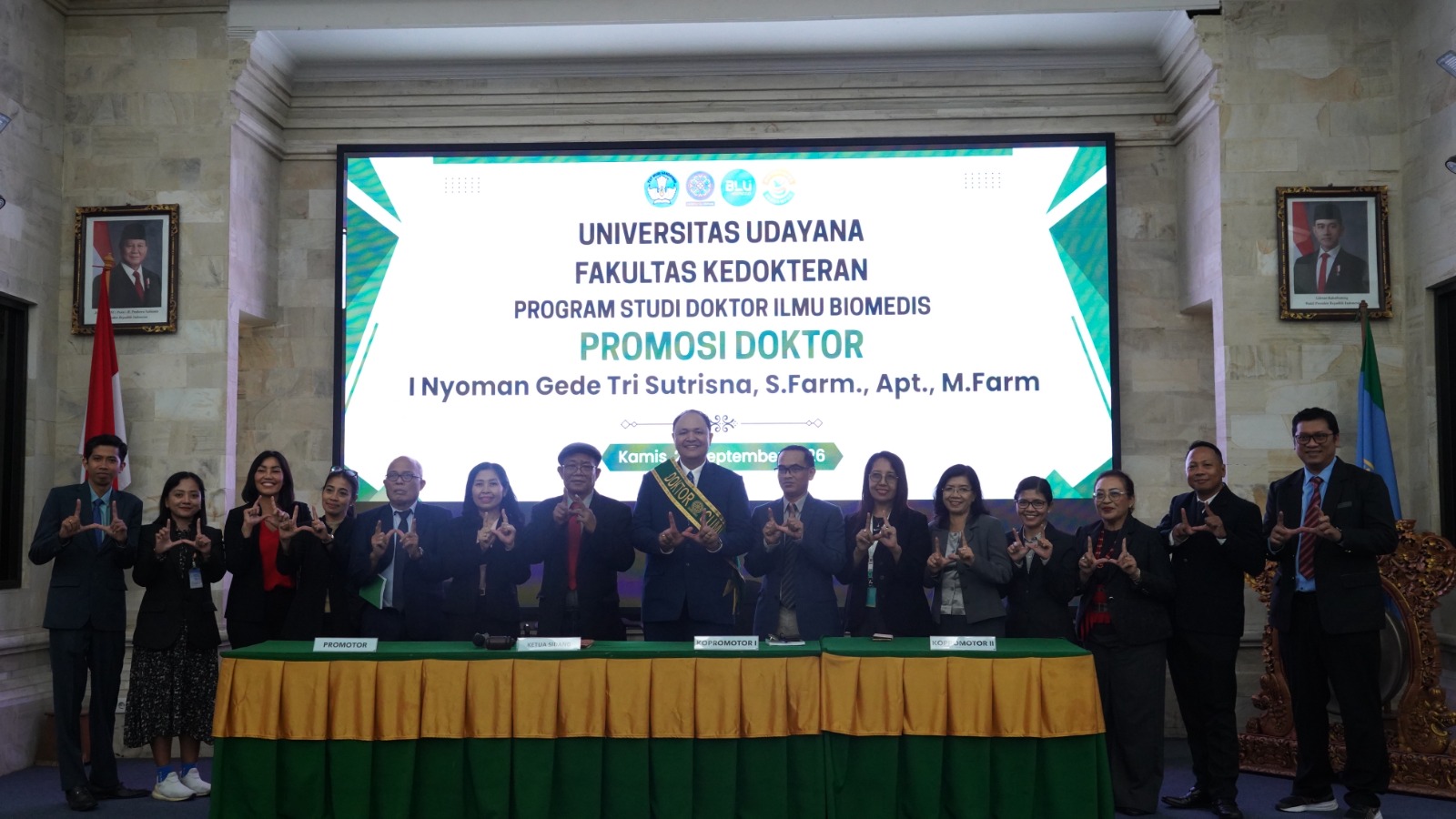
Held at the Dr. A.A. Made Djelantik Meeting Room (4th Floor, Faculty of Medicine Building, Udayana University, Denpasar, Bali), the Doctoral Study Program in Biomedical Sciences at the Udayana University Faculty of Medicine conducted a public doctoral defense for candidate I Nyoman Gede Tri Sutrisna, S.Farm., Apt., M.Farm. The dissertation is titled "Development of Inhalable Eucalyptus Oil Nanoemulsion through Formulation Optimization, Stability Evaluation, and Preclinical Validation in a Pulmonary Inflammation Model." (September 24, 2026)
Pulmonary inflammation caused by cigarette smoke exposure is a complex response involving cellular changes and inflammatory mediators. Eucalyptol, a key bioactive component of eucalyptus oil, has been reported to possess various biological activities relevant to the respiratory system. A systematic review of 35 articles and a bibliometric analysis revealed that research on eucalyptol in respiratory diseases has evolved around three main themes: antimicrobial activity, anti-inflammatory and antioxidant activity, and clinical applications for respiratory diseases. The review also highlighted the need for further development, particularly regarding formulation, stability, and delivery systems. Based on these findings, this study aimed to develop and optimize an inhalable eucalyptus oil nanoemulsion, evaluate its physicochemical characteristics and stability, and conduct preclinical validation using a model of acute pulmonary inflammation induced by cigarette smoke exposure.
The nanoemulsion was developed using a Quality by Design (QbD) approach, employing a Full Factorial Design (2⁴) to evaluate the effects of surfactant and co-surfactant proportions and types on transmittance and viscosity. Sixteen formulas were tested, and the optimum formula was determined using a desirability function. This optimum formula was subsequently characterized based on droplet size, polydispersity index (PDI), zeta potential, pH, transmittance, viscosity, emulsion type, and visual stability. Physicochemical stability was evaluated over three months under accelerated storage conditions (40 ± 2°C and 75 ± 5% RH), while the chemical stability of eucalyptol was assessed using GC-MS. Preclinical validation was conducted on 42 male Wistar rats divided into a normal control group (N), a negative control group (KN), a budesonide positive control group (KKP), and three nanoemulsion groups receiving nominal volumes of 400, 800, and 1600 µL/day (KKU1, KKU2, and KKU3). A pulmonary inflammation model was induced via cigarette smoke exposure over five days. Biological responses were evaluated based on TNF-α and IL-1β levels in serum and lung tissue, as well as neutrophil infiltration observed during histopathological examination.
Optimization results indicated that the optimum formula consisted of 3% eucalyptus oil, 7% PEG 40 HCO, 4% PEG 400, and purified water up to 100 g. This formula yielded predicted values of 92.41% for transmittance and 27.59 cPs for viscosity, with an overall desirability of 0.972. Experimental results showed a transmittance of 94.11% and a viscosity of 24.13 cPs. During three months of accelerated storage, droplet size remained within the 22–25 nm range with a PDI < 0.30. The pH value remained relatively stable, and no phase separation, creaming, or sedimentation was observed. However, this physicochemical stability was not fully mirrored by the chemical stability of the eucalyptol. GC-MS analysis revealed a decrease in the relative eucalyptol content of approximately 25–40% after three months of storage. Given that the method's linearity yielded an R² value of 0.8481, these changes were used to illustrate relative trends during storage rather than to determine absolute content.
In the preclinical validation, the KN group exhibited higher neutrophil infiltration compared to the N group. The KKU1, KKU2, and KKU3 groups showed a significant reduction in neutrophil infiltration compared to the KN group (p = 0.009, p = 0.004, and p < 0.001, respectively). The KKU3 group displayed the lowest level of neutrophil infiltration, differing significantly from KKU1 (p = 0.025), whereas the difference between KKU2 and KKU3 was not significant (p = 0.052). Thus, the reduction in neutrophil infiltration was the most consistent change in the cellular inflammatory response, although this pattern did not yet demonstrate a linear dose-response relationship. Serum TNF-α levels did not differ significantly among the groups. Lung tissue TNF-α levels showed a non-linear pattern, with the highest levels observed in KKU1, while levels in KKU2 and KKU3 did not differ significantly from those in KN. Serum IL-1β levels also showed no significant differences among groups; however, lung tissue IL-1β levels in the KKU1, KKU2, and KKU3 groups were significantly higher than in the KN group. The discrepancy between histopathological responses and cytokine biomarker levels indicates that changes in the inflammatory response did not occur uniformly across all parameters evaluated.
Overall, an inhaled eucalyptus oil nanoemulsion was successfully developed and optimized, exhibiting relatively good physicochemical characteristics that were maintained throughout three months of accelerated storage. However, the decrease in relative eucalyptol content indicates that chemical stability remains an aspect requiring optimization. In an acute lung inflammation model induced by cigarette smoke exposure, the most consistent response observed following nanoemulsion administration was a reduction in neutrophil infiltration, whereas TNF-α and IL-1β levels did not show a consistent pattern of change. Differences in responses across parameters may be related to the specific characteristics and temporal dynamics of each parameter; however, this could not be confirmed as sampling was performed at only a single time point. Furthermore, this study did not determine the specific dose of nanoemulsion or eucalyptol deposited in the lungs, the molecular mechanisms underlying the biological responses, a definitive dose-response relationship, lung function, or specific inhalation safety profiles. Thus, the inhaled eucalyptus oil nanoemulsion can be positioned as a candidate inhalation formulation with preliminary preclinical evidence for modulating lung inflammation, particularly based on histopathological findings of reduced neutrophil infiltration. Further development is required, involving the optimization of chemical stability, characterization of aerosols and lung deposition, evaluation of biological mechanisms, safety studies, and research incorporating multiple observation time points.
The examination was chaired by the Vice Dean for Academic Affairs and Planning at the Faculty of Medicine, Udayana University, Prof. dr. I Made Ady Wirawan, S.Ked., MPH, Ph.D., with an examination team comprising:
1. Prof. Dr. rer. Nat. Drs. I Made Agus Gelgel Wirasuta, Apt., M.Si. (Promoter)
2. Prof. Dr. dr. Ni Made Linawati, S.Ked., M.Si. (Co-promoter I)
3. Prof. Dr. dr. Dyah Kanya Wati, Sp.A. SubSp.ETIA(K) (Co-promoter II)
4. Prof. Dr. dr. Ketut Suryana, Sp.PDKAI., FINASIM
5. Prof. Dr. dr. Desak Made Wihandani, M.Kes
6. Prof. Dr. dr. I Made Jawi, M.Kes
7. Dr.rer.nat. dr. Ni Nyoman Ayu Dewi, M.Si
8. Dr. dr. Dewa Ayu Agus Sri Laksemi, M.Sc
9. Dr. apt. Ketut Agus Adrianta, S.Farm., M.Biomed
With academic invitees:
1. Dr. apt. Dewa Ayu Swastini, S.F., M.Farm
2. Dr. apt. I Gusti Ngurah Jemmy Anton Prasetia, M.Si.
3. Dr. apt. Putu Oka Samirana, S.Farm., M.Sc
4. apt. Made Ary Sarasmita, S.Farm.Klin., Ph.D
5. Dr. apt. I Gusti Ayu Rai Widowati, S.Si., M.Kes., M.H., CMC.
In this examination, Dr. I Nyoman Gede Tri Sutrisna, S.Farm., Apt., M.Farm., was declared to have passed, becoming the 509th graduate of the Doctoral Program in Biomedical Sciences at the Faculty of Medicine, Udayana University, with the distinction of *Cum Laude*.
Gallery





UDAYANA UNIVERSITY